


What to Do After a Houston Car Accident: 5-Step Guide
- fixmycarweb
- hace 2 días
- 12 min de lectura
Imagine you're merging onto the I-610 Loop when a sudden jolt and the sound of crunching metal turn your morning commute into a nightmare. In the immediate aftermath of a collision, adrenaline often clouds your judgment, making it difficult to remember the specific legal requirements for North Houston drivers. It's completely normal to feel a sense of panic regarding insurance denials or the city’s strict SafeClear towing regulations. Understanding exactly what to do after a car accident in Houston is essential to ensuring your physical safety and protecting your vehicle's value.
We know that the moments following a crash are some of the most stressful you'll ever face. You want to ensure you're complying with the Houston Police Department while also securing the evidence needed for a successful insurance claim. This guide provides a meticulous, five step checklist designed to walk you through the process with confidence. We'll cover everything from initial roadside safety to navigating Texas's fault based laws and securing high quality repairs. By following these clear instructions, you can move from the chaos of the scene back to a place of total peace of mind.
Table of Contents
Immediate Steps: Prioritizing Safety at the Houston Accident Scene
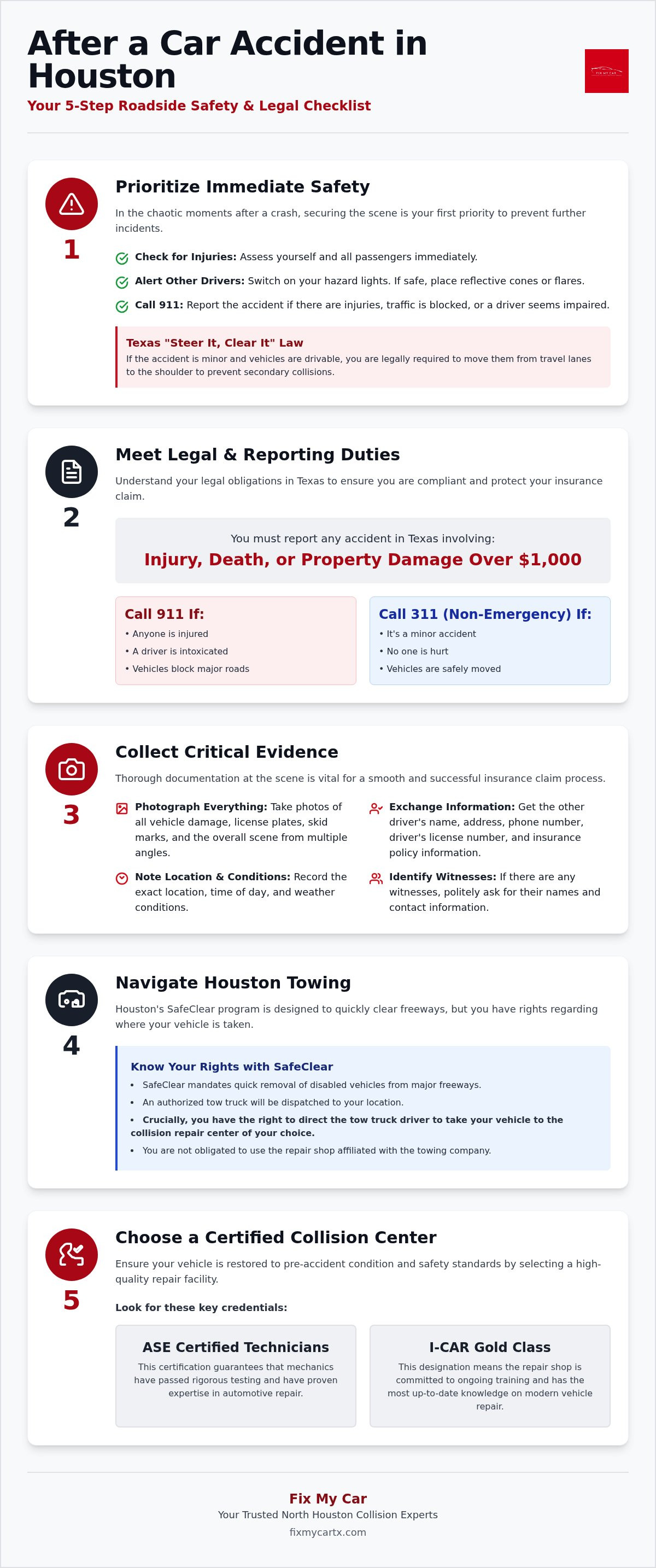
The moments after a traffic collision on a busy Houston road are chaotic. Your heart is racing, and your mind is searching for a plan. Safety is your priority. Before you worry about the car or insurance, you must secure the scene to prevent a bad situation from getting worse. Knowing what to do after car accident houston starts with a calm, methodical assessment of your immediate surroundings to protect yourself and your passengers.
Follow these immediate actions to secure the area:
Check yourself and your passengers for injuries immediately.
Switch on your hazard lights to alert other drivers to the hazard.
If you have flares or reflective cones, set them out at least 50 feet behind your vehicle if it's safe to do so.
Call 911 immediately if anyone is injured, if the vehicles are blocking traffic, or if the other driver seems impaired.
The 'Steer It, Clear It' Law in Texas
Texas law is very clear about your responsibilities on the road. If you're involved in a minor fender bender on a freeway like I-45 or the Beltway 8, and the vehicles are drivable, you're legally required to move them out of the main travel lanes. This is known as the "Steer It, Clear It" law. It helps prevent secondary crashes, which are often more dangerous than the initial impact. If you can safely drive the vehicle to the shoulder or a nearby parking lot, do so immediately. Staying in the main lanes of a high speed Houston highway creates a massive risk for everyone involved. However, if the vehicle is not drivable or if someone is seriously injured, leave the cars where they are and wait for emergency responders to arrive.
Assessing Physical and Emotional Shock
Adrenaline is a powerful mask. In the minutes following a crash, your body is flooded with hormones that can hide significant pain. You might feel fine or just a little shaken up, but internal injuries like whiplash or concussions often take hours or even days to fully manifest. Never refuse a medical evaluation if you feel even slightly off at the scene. Part of knowing what to do after car accident houston is being honest with first responders about your physical state. Stay calm. Speak clearly. Providing accurate information to the police and paramedics creates a reliable record that protects your health and your eventual insurance claim. Taking a moment to breathe and center yourself ensures that you communicate effectively during this high stakes situation.
Houston Legal Requirements: Police Reports and Documentation
Once you've secured your safety, you must address the legal obligations mandated by the city and state. Understanding what to do after car accident houston involves knowing exactly when the law requires a formal police presence. Under the Texas Transportation Code, you are legally required to report a crash that results in injury, death, or property damage estimated at $1,000 or more. Given the high cost of specialized sensors and paint matching in modern vehicles, even a seemingly small impact often crosses this financial threshold.
Calling 911 vs. 311 in Houston
Deciding which number to dial depends entirely on the severity of the scene. Call 911 immediately if there are injuries, if a driver appears intoxicated, or if vehicles are blocking major thoroughfares like the North Freeway. For minor accidents where no one is hurt and vehicles are safely moved, call 311 or the HPD non-emergency line. When speaking to the dispatcher, provide your exact location, the nearest cross street, and a brief description of the vehicles involved. This precise information helps the Houston Police Department or the Harris County Sheriff’s Office dispatch the correct resources to your location in North Houston.
The Texas CR-2 Blue Form
If an officer does not attend the scene, you aren't off the hook for documentation. You should complete a CR-2 form, commonly known as a "Blue Form," to record the incident. This document allows you to self-report the details of the collision while they are still fresh in your mind. It's a vital tool for your insurance company to establish the facts of the case and determine liability. Be sure to include the date, weather conditions, and insurance details for all parties. Although the state no longer requires you to mail these in, keeping a signed copy for your personal records is a smart way to protect your interests during a claim.
To secure a formal peace officer’s crash report (CR-3), you can use the TxDOT Crash Records Information System online portal. As of 2026, a standard copy costs $6, while a certified copy is $8. This report serves as the official word on the accident and is often the first thing an insurance adjuster will request. Having this document in hand makes the transition from the roadside to the repair shop much smoother, as it provides a clear record of what to do after car accident houston to satisfy insurance requirements. If you need help interpreting the damage listed on your report or want to verify the mechanical integrity of your vehicle, we offer free estimates to help you move forward with total confidence.
Evidence Collection: Protecting Your Future Insurance Claim
Once the immediate danger has passed and you've notified the authorities, your focus must shift to preservation. In the high stakes environment of a Houston insurance claim, the quality of your evidence determines the speed and success of your recovery. Memories of the event can become blurred by stress, but digital records provide an objective account of the facts. Learning what to do after car accident houston to document the scene effectively is your best defense against liability disputes.
Identifying witnesses is a critical first step. Look for bystanders or other drivers who stopped to help and ask for their names and phone numbers. Their independent accounts carry significant weight with insurance adjusters. Most importantly, remain professional but guarded. Avoid admitting fault or apologizing for the collision. Even a simple "I'm sorry" can be interpreted as an admission of liability in a legal setting. Similarly, refuse any "handshake" deals to settle for cash on the spot; these agreements are rarely enforceable and often leave you with unpaid mechanical bills.
What Information to Exchange
You have a legal responsibility to share specific details with other drivers involved in the incident. According to the Texas Driver's Handbook, you must provide your contact and insurance information to anyone else involved. To ensure you have a complete file for your claims adjuster, you should collect these five essential pieces of information:
Full names and current contact phone numbers for all drivers and passengers.
Insurance company names and specific policy numbers.
Driver's license numbers and state of issuance.
License plate numbers for every vehicle at the scene.
Vehicle Identification Numbers (VIN), which are usually found on the driver's side dashboard or door jamb.
The Ultimate Scene Photo Checklist
Your smartphone is your most valuable tool for evidence collection. When documenting what to do after car accident houston, aim for a mix of perspective and detail. Start with wide shots that capture the entire intersection or stretch of road, including traffic signals, skid marks, and weather conditions. These photos help reconstruct how the vehicles were moving before the impact. Next, take close up photos of the specific points of impact on all cars involved. Finally, photograph the other driver’s insurance card and license plate directly to avoid transcription errors. This visual proof ensures that no detail is overlooked when it's time for your collision repair estimate and helps your insurance carrier process your claim with fewer delays.
Navigating Houston Logistics: Towing and Medical Care
Once you've documented the scene, the focus shifts to the logistical hurdles of moving your vehicle and protecting your health. Houston's sprawling freeway system has unique rules that can catch drivers off guard. Understanding what to do after car accident houston includes mastering the specifics of vehicle recovery and personal wellness. These steps are not just about convenience. They are about maintaining the integrity of your insurance claim and ensuring you don't face unexpected out of pocket expenses.
How SafeClear Works in Houston
If your accident occurs on a major Houston freeway, you will likely encounter the SafeClear program. This initiative is designed to keep traffic moving by quickly removing stalled or wrecked vehicles from the main lanes. Under this program, only authorized towing companies can clear vehicles from designated freeway segments. It is a mandatory service. You cannot wait for a private motor club or a friend with a trailer if you're blocking a tow away zone. While the initial tow is required to clear the road, you still have rights regarding the final destination of your vehicle. You can request that the tow truck operator take your car directly to a trusted facility like Fix My Car. If you don't specify a location, your car will be taken to a licensed storage lot, which often results in daily storage fees. Always confirm the regulated fee structure with the driver before they hook up your vehicle to avoid surprises.
Medical Documentation for Insurance
Adrenaline often masks pain immediately after a collision. Many drivers make the mistake of telling officers or insurance adjusters "I'm fine" at the scene, only to wake up the next morning with debilitating neck or back pain. In the eyes of an insurance carrier, a delay in seeking medical care is a signal that your injuries aren't serious. To protect your legal case, seek a medical evaluation within 72 hours of the incident. This creates a formal link between the accident and your physical condition. Keep a detailed diary of your symptoms, missed work days, and doctor visits for the first week. This meticulous record keeping is just as important as the mechanical repair process. It ensures that every aspect of your recovery is documented and compensable. After you've addressed your health, you'll need to arrange transportation from the scene. If your car is not drivable, use a ride share service or call a family member rather than staying on the shoulder of a high speed road.
Managing the aftermath of a crash is exhausting, but you don't have to handle the logistics alone. We specialize in helping North Houston drivers restore their vehicles while providing towing assistance to simplify your recovery process.
Restoring Your Vehicle: Choosing a Certified Houston Collision Center
Once the tow truck leaves and the police report is filed, the final stage of knowing what to do after car accident houston is selecting a repair facility that prioritizes your long term safety. Modern vehicles are complex machines with integrated technology. Restoring them requires more than just a fresh coat of paint; it demands a deep understanding of structural integrity and digital safety systems. Choosing a certified center ensures that your vehicle's frame, sensors, and mechanical components are returned to their exact factory specifications.
The difference between a standard repair and a certified restoration often comes down to the parts used. While aftermarket parts are common, Original Equipment Manufacturer (OEM) parts are designed specifically for your vehicle's make and model, ensuring a perfect fit and predictable performance in future impacts. We focus on these details because we believe every guest deserves a vehicle that is as safe as it was the day it left the showroom floor.
The Value of I-CAR Gold Class and ASE Certification
Airbags, lane departure warnings, and crumple zones are only effective if they are recalibrated correctly after a crash. Our ASE-certified technicians have the technical expertise to handle these intricate repairs with meticulous precision. I-CAR Gold Class is the industry's highest training standard for collision repair professionals. North Houston drivers trust our team because we don't just fix the visible dents. We thoroughly inspect the underlying structure and mechanical systems to ensure your car's safety architecture remains intact. This commitment to training means we can handle everything from air bag service to complex frame straightening with total confidence.
Seamless Insurance Handling at Fix My Car
The paperwork involved in a claim can be overwhelming when you're already dealing with the stress of an accident. We simplify the process by working directly with your insurance provider to streamline the estimate and approval stages. Our team acts as your advocate, ensuring that the repair plan covers all necessary mechanical and collision work. To keep your life moving while your vehicle is in our shop, we offer complimentary ride share services for our customers. This allows you to return to your daily routine in North Houston while our experts handle the heavy lifting. When you're deciding what to do after car accident houston to get back on the road, choosing a partner who handles the logistics is the best way to secure your peace of mind.
Get a Free Collision Repair Estimate in Houston today and let our professional team restore your vehicle to its highest standards.
Getting Back on the Road with Confidence
Dealing with a collision is a major disruption, but following a clear plan helps you regain control and protect your interests. We've covered the essential logistics of the "Steer It, Clear It" law and the importance of securing a formal police report to satisfy insurance requirements. By prioritizing meticulous evidence collection and seeking medical care within 72 hours, you ensure that every detail of your recovery is fully documented. Understanding what to do after car accident houston allows you to move past the initial shock and focus on a high quality restoration.
Our team is here to handle the technical heavy lifting so you don't have to. As an I-CAR Gold Class Certified Shop with ASE-certified mechanical technicians, we take pride in returning your vehicle to its pre-accident safety standards. We even offer complimentary ride-share services for our customers to minimize any further stress on your schedule. You deserve a repair process that feels effortless and professional. Schedule Your Free Houston Collision Estimate at Fix My Car today. We look forward to helping you get back to your normal routine with total peace of mind.
Frequently Asked Questions
Do I have to call the police for a minor accident in Houston?
You must call the police if the collision results in injury or if property damage appears to exceed $1,000. While very minor incidents can sometimes be self-reported, most modern vehicles reach that $1,000 threshold quickly due to the high cost of paint matching and safety sensors. Having an HPD officer document the scene provides an official record that protects you during the insurance claim process.
What is the Houston SafeClear program and how does it affect me?
SafeClear is a mandatory program that requires stalled or wrecked vehicles to be towed off Houston freeways immediately to prevent traffic congestion. If your car is disabled on a major thoroughfare, an authorized SafeClear tow truck will move you to a safe location for a regulated fee. You still have the right to choose where your vehicle is ultimately taken for repairs after it is cleared from the freeway.
How long do I have to report a car accident in Texas?
Texas law requires you to report a crash immediately if there are injuries or significant damage. If a police officer does not attend the scene and the damage exceeds $1,000, you have 10 days to file a report with the Texas Department of Transportation. Knowing exactly what to do after car accident houston includes meeting these deadlines to ensure your insurance coverage remains valid and you stay legally compliant.
Can I choose my own repair shop after an insurance claim in Houston?
You have the absolute legal right in Texas to choose any repair shop you prefer for your vehicle. Insurance companies often provide a list of preferred facilities, but they cannot force you to use them. Selecting a local expert ensures your car is restored by technicians who prioritize your safety and factory standards rather than the insurance company's cost-saving goals.
What should I do if the other driver doesn't have insurance?
Contact the police immediately so they can document the other driver's lack of coverage in an official report. You should then file a claim with your own insurance company under your Uninsured Motorist (UM) policy. This coverage is designed to pay for your mechanical repairs and medical expenses when the at-fault party fails to carry the state-mandated minimum liability insurance.
How do I get a copy of my HPD accident report?
You can purchase a copy of your official CR-3 crash report through the TxDOT Crash Records Information System online portal. As of 2026, a standard digital copy costs $6, while a certified copy is $8. You'll need the date of the accident and the driver's license number or Vehicle Identification Number (VIN) to find your specific report in the system.
Is it safe to drive my car after a minor collision?
It is often unsafe to drive a vehicle after any impact because hidden mechanical damage can compromise your safety. Modern cars use sensitive sensors and complex structural components that may be damaged even if the exterior looks fine. We recommend a professional safety inspection to verify that your brakes, steering, and airbag systems are fully functional before you get back on the road.
What are the benefits of using an I-CAR Gold Class body shop?
Using an I-CAR Gold Class shop ensures your vehicle is repaired by technicians who have completed the industry's most rigorous and up-to-date training. This certification is vital for correctly handling the advanced high-strength steels and electronic safety systems in modern vehicles. When deciding what to do after car accident houston, choosing a Gold Class facility guarantees a meticulous restoration that meets original factory safety standards.


Comentarios