


Car Suspension Repair in Houston: A Driver’s Safety & Comfort Checklist
You’re navigating the North Houston morning rush when a familiar pothole on I-45 sends a jarring shudder through your steering wheel, leaving you wondering if you need the professional car suspension repair houston roads often demand. It’s frustrating when your daily commute feels more like an off-road expedition, especially when you value the safety of your family and the longevity of your vehicle. We understand that a shaky ride creates more than just physical discomfort; it brings a sense of anxiety about your car’s reliability and the potential costs ahead.
Since Texas ended mandatory annual safety inspections in 2025, the responsibility for catching mechanical wear falls squarely on your shoulders. This guide provides the clarity you need to identify early warning signs before they turn into expensive structural damage. We will walk through a comprehensive safety checklist, explain how Houston’s unique road conditions impact your struts and shocks, and show you how to restore that smooth, quiet ride you deserve. From understanding technical nuances to navigating the repair process with transparency, you’ll gain the confidence to keep your vehicle handling precisely as it should.
Table of Contents
Recognizing Suspension Trouble on Houston Roads
Houston is famous for its sprawling highways, but the constant expansion projects and deep potholes are notorious "suspension killers." Driving through North Houston construction zones puts immense stress on every component under your car. Over time, these repeated impacts compromise your vehicle suspension system, leading to a ride that feels more like a boat on choppy water than a precision machine. If you suspect your car is struggling, you don't always need a professional lift to start investigating.
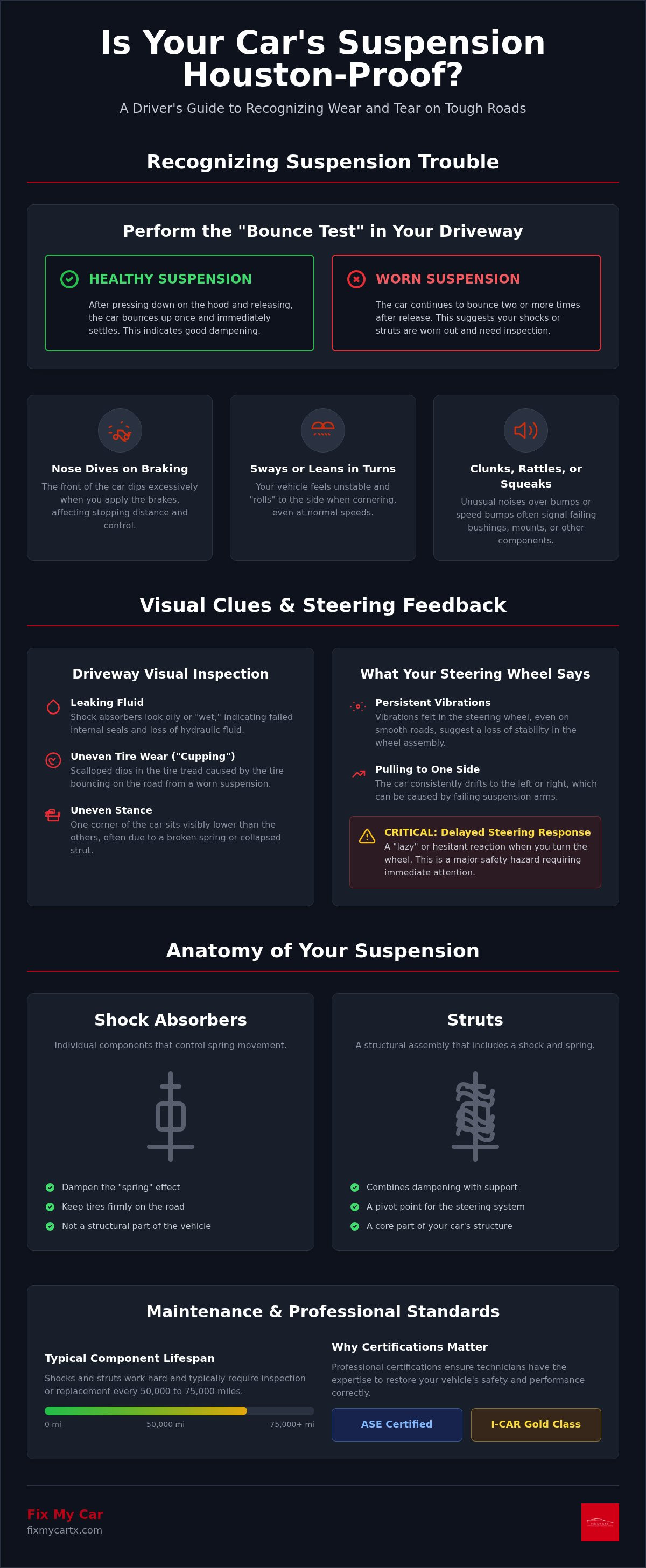
You can perform a "Bounce Test" right in your driveway. Walk to the front of your car and press down with all your weight on the hood. Release it and watch how the car reacts. It should bounce up once and settle immediately. If it continues to oscillate or "bounce" several times, your shocks or struts are likely worn out. This lack of dampening is a clear indicator that it's time to look for car suspension repair houston specialists who understand these local road conditions.
Pay close attention to how the car behaves during transitions. Does the nose of the vehicle "dive" toward the pavement when you hit the brakes? Do you feel the body leaning heavily or "swaying" when you take a turn at normal speeds? These aren't just comfort issues; they are safety risks that affect your ability to stop and steer effectively. Strange noises are another giveaway. Listen for metallic clunks over speed bumps or persistent squeaks when you enter your driveway. These sounds often mean bushings have failed or a strut mount has loosened.
Visual Symptoms You Can Spot in Your Driveway
Sometimes, the evidence is purely visual. Peer behind your wheels with a flashlight to check the exterior of your shock absorbers. If they look "wet" or covered in oily grime, the internal seals have likely failed and are leaking hydraulic fluid. You should also examine your tires for "cupping." This looks like smooth, scalloped dips in the tread. It happens when a worn suspension allows the tire to literally bounce down the road, wearing away rubber unevenly. Finally, stand back and look at the car's stance. If one corner sits lower than the others, you probably have a broken spring or a collapsed strut.
Driving Feedback: What Your Steering Wheel is Telling You
Your steering wheel acts as a direct line of communication from the road. If you feel persistent vibrations while driving on perfectly smooth pavement, your suspension may no longer be holding the wheel assembly steady. A "pulling" sensation to one side is often blamed on alignment, but it can also be caused by a sticking caliper or a failing suspension arm. The most dangerous sign is delayed steering response. If you turn the wheel and the car feels "lazy" or hesitant to follow, it's a critical safety red flag. In these cases, seeking car suspension repair houston services becomes an immediate priority to ensure you maintain control during emergency maneuvers.
The Anatomy of Your Vehicle’s Suspension System
Your vehicle’s suspension isn't just a single part. It's an intricate network of components working in harmony to manage the friction between your tires and the pavement. By connecting the vehicle to its wheels, this system ensures that every impact from a Houston pothole is managed before it reaches the cabin. Without this setup, the energy from every bump would transfer directly to the frame, making the car nearly impossible to control. It's the silent protector of your vehicle's structural integrity.
Springs are the heavy lifters of this assembly. They support the entire weight of your vehicle and absorb the initial energy of an impact. Whether your car uses coil springs or leaf springs, their primary job is to keep the chassis at a specific height. However, springs alone would cause the car to bounce uncontrollably. This is why dampeners are essential for stability. If you feel your car sagging or sitting unevenly, specialized car suspension repair houston services can help identify if a spring has lost its tension or snapped.
Shock Absorbers and Struts: The Core Components
Many drivers use the terms "shocks" and "struts" interchangeably, but they serve distinct roles. Shock absorbers are individual components that dampen the "spring" effect, ensuring your tires stay firmly planted on the road. Struts are more complex. They are a structural part of the suspension and steering system, often replacing the upper control arm and serving as a pivot point for steering. Because these parts work so hard, they typically wear out every 50,000 to 75,000 miles. If your odometer is climbing, a professional mechanical inspection can determine if your components still meet manufacturer safety standards.
Ball Joints, Bushings, and Tie Rods
If shocks and struts are the muscles, then ball joints and bushings are the joints. Ball joints allow your wheels to move up and down for bumps and side-to-side for steering at the same time. They are critical for maintaining a stable footprint. Meanwhile, rubber bushings act as cushions between metal parts to reduce noise and vibration. In North Houston, our extreme summer heat causes these rubber parts to dry out and perish faster than in cooler climates. Finally, tie rods provide the essential link between your steering gear and the wheel assembly. When these components fail, your car’s handling becomes unpredictable. Investing in timely car suspension repair houston ensures these joints remain secure, preventing a total loss of steering control during a commute.
Repair or Replace? A Decision-Making Checklist
Deciding whether to patch a small issue or invest in a total overhaul is a common dilemma for North Houston drivers. If your vehicle is approaching the 100,000-mile mark, you're likely seeing the cumulative effects of heat and heavy traffic on your undercarriage. While some repairs are about restoring that "new car" feel, others are strictly about keeping you on the road safely. We believe in transparency, so we help you prioritize what needs immediate attention versus what can wait.
When it's time to act, we always recommend replacing components like shocks or struts in pairs. Even if only one side is leaking, the other has likely endured the same number of miles. Installing a single new part creates an imbalance in handling and weight distribution. This puts extra stress on the older component, often causing it to fail shortly after. By addressing both at once, you ensure consistent performance and save on labor costs in the long run. Ignoring these minor signs of wear doesn't just result in a bumpy ride; it creates a domino effect. Worn shocks force your tires to work harder, leading to rapid tread wear and reduced braking efficiency.
The 'Critical Safety' Checklist
Safety is non-negotiable. If you're experiencing any of the following, car suspension repair houston experts consider these high-priority fixes that shouldn't be delayed:
Instability: Does the car sway or feel "top-heavy" during lane changes on the Beltway?
Braking Issues: Are you noticing increased stopping distances or a "nose-dive" sensation when you hit the brakes?
Steering Disconnect: Does the steering feel loose, as if there is a "dead zone" or delay between your input and the car's movement?
Understanding the Total Cost of Ownership
Maintaining your suspension is a smart financial move. A healthy system protects your tires from "cupping" and prevents premature wear on your brake pads. It also improves fuel efficiency by ensuring your wheels maintain optimal contact with the road. Beyond the immediate drive, a well-documented maintenance history significantly boosts your vehicle’s resale value. If you're looking for a partner to help manage these costs, you can learn more about mechanical repair in Houston TX to protect your investment. Addressing these issues early prevents a minor fix from turning into a multi-system overhaul. We're here to guide you through that choice with honest, neighborly advice.
The Houston Driver’s Suspension Maintenance Checklist
Living in North Houston means dealing with a unique combination of extreme summer heat and a distinct "pothole season." This season typically follows our winter rains, when water seeps into pavement cracks and creates deep craters across major thoroughfares like I-45 and the Beltway. Being proactive about your maintenance schedule can save you from a sudden, expensive car suspension repair houston experts often see after a heavy storm cycle. By following a consistent checklist, you can extend the life of your shocks and ensure your vehicle remains a sanctuary of comfort during your daily commute.
Maintaining proper tire pressure is one of the simplest ways to assist your suspension. When tires are under-inflated, they can't absorb minor road vibrations effectively, forcing your struts to work harder to compensate. Similarly, keeping your undercarriage clean helps. Houston road debris and grime can trap heat around rubber bushings, causing them to crack and perish prematurely in our 100-plus degree summers. A quick rinse of the wheel wells during your weekly car wash can go a long way in preserving these delicate "joints."
Post-Impact Inspection Routine
Sometimes, avoiding a pothole is impossible. If you experience a significant impact, pull over when it's safe and perform a quick visual check of your wheels. Look for bent rims or any fluid dripping from behind the tire. If your steering wheel is no longer centered or the car feels "jittery" at highway speeds, don't wait for your next oil change to seek a professional estimate. Catching a bent tie rod or a shifted strut early prevents that damage from spreading to your steering rack or tires. North Houston drivers should inspect their suspension every 12,000 miles to catch minor bushing tears or fluid leaks before they compromise vehicle safety.
The Role of Alignment in Suspension Health
Alignment and suspension are two sides of the same coin. A simple alignment check ensures your tires are pointing exactly where they should, which prevents the "pulling" sensation that puts constant tension on your control arms. On Houston’s high-speed highways, even a slight misalignment can cause rapid, uneven tire wear and vibration. If you find yourself constantly fighting the steering wheel to stay straight, your alignment has likely been knocked out of spec by local road conditions. Regular adjustments keep your handling sharp and prevent premature wear on your brand-new suspension components. If you suspect your vehicle’s balance is off, you can schedule a professional alignment check to restore your peace of mind and protect your tires.
Why Choose Fix My Car for Houston Suspension Repair?
Choosing a shop for your car suspension repair houston needs shouldn't add to the stress of a bumpy ride. At Fix My Car, we combine the technical precision of a high-end facility with the welcoming atmosphere of a neighborhood staple. Our team consists of ASE-certified technicians who specialize in the complex mechanical work required to keep your vehicle stable. Whether your suspension has worn down over years of commuting or was damaged in a sudden North Houston accident, we have the specialized training to diagnose and resolve the issue correctly the first time.
Many local shops focus only on routine maintenance, but our I-CAR Gold Class certification means we understand the critical intersection between collision repair and suspension health. If your vehicle has suffered a curb impact or a collision, the damage often goes deeper than just a bent wheel. We look for structural shifts and frame alignment issues that others might miss. We prioritize transparency in every interaction. When you visit us, you receive a clear, detailed estimate with no hidden fees or unnecessary upsells. We treat your vehicle with meticulous care, ensuring every bolt is torqued to manufacturer specifications.
Precision and Meticulous Care in Every Repair
High-quality parts are non-negotiable for Houston roads. We use components designed to withstand our local climate and harsh road conditions, ensuring your repair provides long-term reliability. Our diagnostic process is thorough. We provide you with a comprehensive report so you understand exactly what is happening under your car. This commitment to restoring your vehicle to its original manufacturer standards is why our guests trust us with their family’s safety. We take immense pride in our craft, treating every vehicle as if it were our own.
Stress-Free Logistics for Busy Houstonians
We know your time is valuable. Dealing with insurance after an accident is often the most frustrating part of the repair process, which is why we handle those logistics for you. If your suspension damage is part of a larger insurance claim, see our guide on professional collision repair in North Houston for a deeper look at our structural restoration process. To keep your day moving while we work, we offer a complimentary ride-share service for our customers. From the moment you receive your free estimate to the final test drive, we make the car suspension repair houston experience professional and effortless.
Restore Your Confidence on the Road
Houston roads are notoriously tough on your vehicle, but your commute doesn't have to be a daily struggle. We’ve explored how to identify early warning signs, the critical role of your suspension’s anatomy, and how to maintain your vehicle despite our local climate. By staying proactive with the checklist provided, you can avoid the cascading costs of tire and brake damage. When you're ready for the professional car suspension repair houston drivers rely on, you need a partner who prioritizes your safety and peace of mind.
Our shop in North Houston blends technical authority with neighborly care. With ASE-Certified Technicians and I-CAR Gold Class standards, we ensure every repair meets the highest levels of precision. We believe in transparency, which is why we offer free professional estimates to help you make informed decisions without any pressure. You deserve a smooth, quiet ride and a vehicle that handles perfectly in every Houston lane change.
Schedule your free suspension estimate at Fix My Car in North Houston today! We look forward to restoring your vehicle's performance and giving you the comfortable driving experience you deserve.
Frequently Asked Questions
How much does car suspension repair cost in Houston?
Costs vary significantly based on whether you're replacing a single bushing or a complete strut assembly. While minor repairs can stay under a few hundred dollars, complex luxury air suspensions can exceed a thousand per wheel. We focus on providing transparent, free estimates because every vehicle's needs are unique. This ensures you only pay for the specific components your car requires to return to its original handling and safety standards.
How long can I drive with a bad suspension?
You should address suspension issues as soon as you notice them because driving with worn components is a major safety risk. A bad suspension increases your stopping distance and makes emergency maneuvers unpredictable. While the car might still move, you're causing cumulative damage to your tires and brakes. It's best to seek car suspension repair houston experts immediately to prevent a minor leak from turning into a dangerous structural failure.
What are the most common suspension problems in Houston?
Blown shock absorbers and worn out rubber bushings are the most frequent issues we see in North Houston. Our extreme summer heat causes rubber parts to dry out and crack much faster than in other regions. Additionally, constant road construction leads to bent tie rods and shifted alignments. These problems often manifest as strange clunking noises or a car that drifts to one side while you're trying to drive straight.
Does insurance cover suspension repair after hitting a pothole?
Insurance coverage typically depends on your specific policy and whether the pothole impact is classified as a single event accident. If the impact caused sudden, visible damage like a bent control arm, your collision coverage might apply. However, insurance rarely covers gradual wear and tear. We recommend checking your policy details. As an I-CAR Gold Class shop, we often assist guests by coordinating with insurance providers for accident related suspension repairs.
Is it worth fixing the suspension on an older car?
Fixing the suspension on an older vehicle is often a smart investment because it directly impacts safety and prevents more expensive secondary damage. With the average age of vehicles in the U.S. reaching 12.6 years, many drivers choose to refresh these components to extend their car's life. Restoring the suspension protects your tires and improves fuel efficiency. We help you weigh the repair cost against the vehicle's value with a transparent diagnostic report.
What is the difference between a shock and a strut?
A shock absorber is a standalone component that dampens the bouncing of your car's springs. A strut is a more complex, structural part of the suspension and steering system. Struts often serve as a pivot point for the steering and support the weight of the vehicle. Because struts are integral to the car's structure, they are generally more expensive and labor intensive to replace than simple shock absorbers during a mechanical repair.
How often should I have my suspension inspected?
We recommend a professional suspension inspection every 12,000 miles or during every other oil change. In Houston, it's also wise to have a check up after the rainy season when potholes are at their peak. Since Texas no longer requires annual safety inspections for most vehicles, the responsibility for identifying worn ball joints or leaking struts falls on you. Regular checks catch small leaks before they compromise your steering control.
Can a bad suspension cause my car to shake at high speeds?
Yes, a worn suspension is a common cause of vehicle shaking at high speeds. When components like bushings or tie rods become loose, they allow the wheels to vibrate rather than tracking smoothly. This vibration often worsens on Houston's highways where speeds are higher. If you feel a jittery sensation through the steering wheel or seat, it's a sign that your car suspension repair houston needs have become an urgent safety priority.


Comentarios